













![Kong Interview Preparation Guide [2025]](https://www.devopstraininginstitute.com/blog/uploads/images/202509/image_430x256_68dbb95326997.jpg)







Top 12 API Testing Tools for DevOps Teams
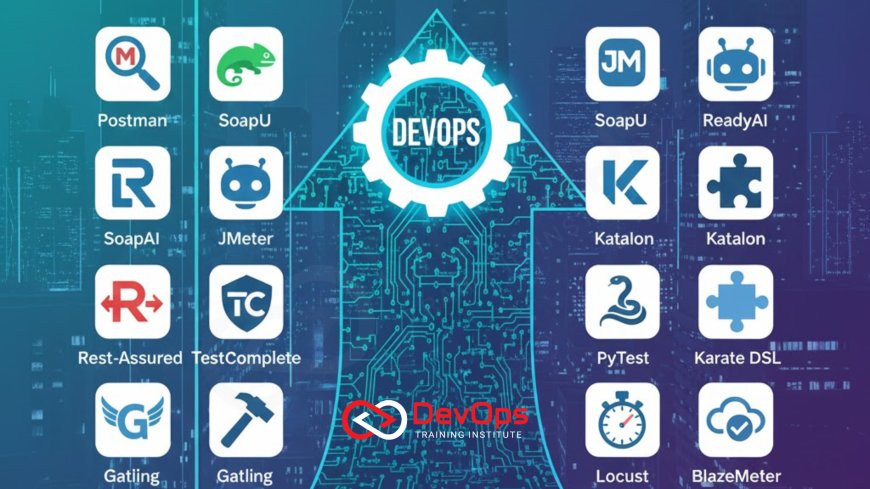
Discover the top 12 API testing tools every DevOps and QA team should know in 2025. From beginner-friendly GUI tools to powerful CLI and automation solutions, this comprehensive guide compares features, pricing, integrations, learning curve, and real-world use cases. Whether you're testing REST, GraphQL, SOAP, or gRPC APIs in CI/CD pipelines, these tools help you catch bugs early, improve reliability, and ship faster with confidence. Includes Postman, Rest-Assured, SoapUI, Karate, JMeter, and more.
Introduction
APIs are the backbone of modern applications. Microservices, mobile apps, serverless functions, and third-party integrations all depend on reliable, well-tested APIs. In a DevOps world where teams deploy multiple times a day, manual API testing is no longer sustainable. Automated API testing integrated into your CI/CD pipeline catches bugs early, prevents production outages, and gives developers instant feedback. The right tool can save hundreds of hours while improving quality dramatically.
This guide reviews the 12 most popular and powerful API testing tools used by DevOps teams today. We cover everything from GUI-based tools perfect for beginners to code-first frameworks loved by engineers, and enterprise platforms built for scale. Each tool is evaluated on ease of use, automation capabilities, CI/CD integration, team collaboration, and cost so you can pick the best fit for your stack and maturity level.
1. Postman
Postman remains the undisputed leader in API development and testing with over 30 million users worldwide. Originally a simple Chrome extension, it has evolved into a full API platform.
- Intuitive GUI for building requests, collections, and environments
- Powerful collection runner for automated testing with assertions
- Mock servers, API documentation, and monitoring in one place
- Newman CLI for running collections in CI/CD
- Team workspaces with role-based access and version control
- Free tier is very generous; paid plans start at $12/user/month
Best for teams that want an all-in-one API platform with minimal learning curve. Even non-technical members can create and run tests.
2. Rest-Assured
Rest-Assured is a Java DSL specifically designed for testing REST services. It reads like English, making tests extremely readable.
- Fluent API: given().when().get("/users").then().statusCode(200)
- Built-in support for JSONPath, XMLPath, Hamcrest matchers
- Seamless integration with TestNG, JUnit, and Spring Boot
- No GUI – pure code, perfect for developers
- Excellent for contract testing and BDD-style specifications
Ideal for Java/Kotlin teams who prefer code over GUI and want tests that live alongside application code.
3. SoapUI / ReadyAPI
SoapUI is the most mature tool for SOAP and REST testing. ReadyAPI is the commercial version with extra enterprise features.
- Full support for SOAP, REST, GraphQL, JMS, JDBC
- Point-and-click test creation with data-driven testing
- Load and security testing modules
- Smart assertion wizard and Groovy scripting
- SoapUI Open Source is free; ReadyAPI starts at ~$700/year
Still the go-to choice for legacy SOAP services and regulated industries needing security scans.
4. Karate DSL
Karate is an open-source framework that combines API testing, mocks, performance testing, and UI testing in one tool – using simple Gherkin syntax.
- No JavaScript or Java coding required for most tests
- Built-in mock server and parallel execution
- Native JSON/CSV data-driven testing
- Excellent GraphQL and WebSocket support
- Runs on JUnit – perfect for Maven/Gradle CI pipelines
Many teams switching from Postman love Karate because tests are readable by everyone yet powerful enough for complex scenarios.
5. JMeter
Apache JMeter started as a load testing tool but is widely used for functional API testing thanks to its flexibility.
- Supports HTTP, SOAP, JDBC, FTP, JMS, and more
- Highly extensible with plugins
- Great for performance and stress testing APIs
- Can simulate thousands of virtual users
- Free and open source
Best when you need both functional and load testing in one tool.
6. Hoppscotch (formerly Postwoman)
Open-source, lightweight, and beautiful alternative to Postman that works entirely in the browser or as a desktop app.
- Zero installation – just open and start testing
- Supports REST, GraphQL, WebSocket, SSE
- Self-hostable or use the cloud version
- Collection export/import collections
- Completely free and privacy-focused
Perfect for developers who want speed and don’t need enterprise governance features.
7. Insomnia
Insomnia is a modern, open-core API client with strong Git sync and team collaboration features.
- Clean interface similar to Postman
- Git-based sync for teams (Insomnia Cloud or self-hosted Git)
- GraphQL introspection and query editor
- Environment variables, code generation, mock servers
- Free core; Teams plan $12/user/month
Gaining rapid adoption among teams tired of Postman’s pricing model.
8. Bruno
The newest contender in 2025 – Bruno stores collections directly in Git using plain files (Bru format) instead of databases.
- 100% offline, zero cloud dependency
- Git-friendly: no merge conflicts on collections
- Scripting with Bru language (similar to JavaScript)
- Completely free and open source
Perfect for teams obsessed with GitOps and version-controlled everything.
9. K6 by Grafana Labs
K6 is a modern load testing tool that uses JavaScript/ES6 for scripting and integrates beautifully with CI/CD.
- Developer-centric: write tests in code
- Designed for Git and CI from day one
- Can also do functional API testing
- Distributed load testing with k6 cloud
- Open source core; cloud plans available
Best for teams that want performance testing written by developers in the same repo as code.
10. Pact
Pact is the leader in contract testing – ensuring consumer and provider services stay compatible.
- Consumer-driven contract testing
- Prevents breaking changes across microservices
- Pact Broker for sharing contracts
- Supports multiple languages (JVM, .NET, JS, etc.)
- Free and open source
Essential for mature microservices architectures.
11. Airborne
Lightweight Ruby gem for API testing built on RSpec. Very popular in Rails communities.
- Tests read like RSpec examples
- Automatic JSON validation
- Great for TDD/BDD API development
12. Tavern
Python testing tool using simple YAML files and pytest. Great for teams that love pytest and want readable API tests.
- No code required for most tests
- Built-in support for MQTT, WebSocket
- Excellent pytest integration
Conclusion
The best API testing tool depends on your team size, technical preferences, and maturity level. Beginners and mixed teams usually start with Postman or Hoppscotch because of their friendly interfaces. Engineering-heavy teams often choose Karate, Rest-Assured, or K6 for code-first approaches that live in Git alongside application code. Enterprises with legacy SOAP or strict governance lean toward ReadyAPI. Modern cloud-native teams love Bruno and Pact for GitOps alignment.
Remember: the most high-performing teams use more than one tool. Postman for exploration and documentation, Karate or Rest-Assured for automated regression in CI/CD, and K6 or JMeter for performance. Start simple, automate gradually, and integrate into your pipeline early. When your APIs include serverless functions, always account for AWS Lambda limits in your tests to avoid surprises in production. Done right, API testing becomes a superpower that lets you deploy with confidence multiple times per day.
Frequently Asked Questions
What is API testing and why is it important in DevOps?
API testing validates that your application programming interfaces work correctly, return expected data, handle errors gracefully, and perform well under load. In DevOps, automated API tests in CI/CD pipelines catch issues before they reach production.
Which API testing tool is best for beginners?
Postman and Hoppscotch have the lowest learning curve with beautiful GUIs and no coding required for basic tests.
Can I use Postman for automated testing in CI/CD?
Yes – use Newman (Postman’s CLI) to run collections headless in Jenkins, GitHub Actions, GitLab CI, etc.
What’s the difference between API testing and contract testing?
API testing checks functionality, performance, security. Contract testing (Pact) ensures consumer and provider agree on the API shape.
Should API tests be written by developers or QA?
Best practice: developers write unit/integration API tests, QA owns end-to-end and exploratory testing. Collaboration wins.
Which tool has the best GraphQL support?
Postman, Insomnia, Hoppscotch, and Karate all have excellent GraphQL editors and introspection.
How do I test AWS Lambda functions automatically?
Use tools like Karate, Rest-Assured, or Serverless Framework with plugins. Always respect AWS Lambda timeout and payload limits in your test data.
Is it possible to do load testing with these tools?
Yes – K6, JMeter, and Gatling are purpose-built for load. Postman and Karate can also simulate moderate load.
Which tool is completely free and open source?
Hoppscotch, Bruno, Karate, Rest-Assured, K6, Pact, and Tavern are fully open source with no paid tiers required.
How do I choose between Postman and Insomnia?
Choose Postman for team collaboration and monitoring. Choose Insomnia or Bruno if you want Git-based workflows and avoid vendor lock-in.
Can these tools test gRPC APIs?
Postman, Insomnia, Hoppscotch, and Karate have native gRPC support. JMeter requires plugins.
What about WebSocket or Server-Sent Events testing?
Karate, Tavern, and Hoppscotch have excellent real-time protocol support out of the box.
Should API tests live in the same repo as code?
Yes – this enables “tests as documentation” and prevents drift. Tools like Karate, Rest-Assured, and Bruno make this natural.
How do I handle authentication in API tests?
All major tools support OAuth2, JWT, API keys, Basic Auth, and custom headers. Store secrets securely using environment variables.
What’s the future of API testing?
AI-assisted test generation, deeper GitOps integration, and automatic contract evolution are the big trends for 2025 and beyond.
What's Your Reaction?
 Like
0
Like
0
 Dislike
0
Dislike
0
 Love
0
Love
0
 Funny
0
Funny
0
 Angry
0
Angry
0
 Sad
0
Sad
0
 Wow
0
Wow
0


![100+ Azure DevOps Interview Questions and Answers [Updated 2025]](https://www.devopstraininginstitute.com/blog/uploads/images/202509/image_140x98_68c40aa9a3834.jpg)






![Future Scope of DevOps Careers in Pune [Updated 2025]](https://www.devopstraininginstitute.com/blog/uploads/images/202510/image_140x98_68e3a84652312.jpg)