














![Kong Interview Preparation Guide [2025]](https://www.devopstraininginstitute.com/blog/uploads/images/202509/image_430x256_68dbb95326997.jpg)







Top 15 Cloud Deployment Strategies for DevOps
Explore the top 15 cloud deployment strategies every DevOps team should know in 2025. From blue-green and canary to serverless and GitOps, learn proven techniques to deploy faster, safer, and with zero downtime in AWS, Azure, and GCP.

Introduction
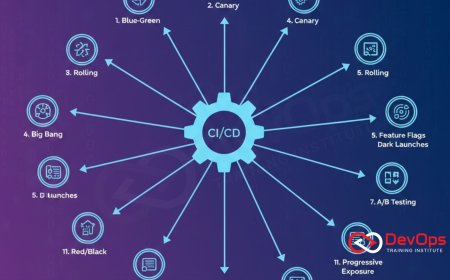
In modern DevOps, how you deploy is just as important as what you deploy. The right cloud deployment strategy reduces risk, eliminates downtime, and lets you release features multiple times a day with confidence — even when dealing with AWS Lambda timeout and payload limits. Whether you're running containers on Kubernetes, serverless functions, or traditional VMs, there’s a strategy that fits your needs. Here are the top 15 proven cloud deployment strategies used by leading DevOps teams in 2025.
1. Blue-Green Deployment
- Two identical environments: Blue (live) and Green (new version)
- Deploy new version to Green, test thoroughly
- Switch traffic instantly via load balancer or DNS
- Zero downtime and instant rollback
- Popular on AWS Elastic Beanstalk, Azure App Service
2. Canary Deployment
Roll out the new version to a small percentage of users first. Monitor metrics and error rates before gradually increasing traffic. Perfect for catching issues early with minimal user impact. Tools like Argo Rollouts and AWS CodeDeploy support this natively.
3. Rolling Deployment
- Update instances one by one or in small batches
- No additional infrastructure needed
- Slow but simple and cost-effective
- Built into Kubernetes by default
- Good for stateful applications
4. Recreate (Big Bang) Deployment
Shut down the old version completely and start the new one. Fastest and simplest, but causes downtime. Only suitable for non-critical apps or during maintenance windows.
5. Shadow Deployment
- New version runs alongside production but doesn’t serve real traffic
- Real user requests are mirrored to shadow version
- Tests performance and behavior under real load
- Used by Netflix and LinkedIn for high-stakes releases
6. A/B Testing Deployment
Route different user segments to different versions simultaneously. Compare business metrics like conversion rates, not just technical health. Great for validating product changes before full rollout.
7. Feature Flag (Toggle) Deployment
- Deploy code to production but hide behind feature flags
- Enable features for specific users or gradually
- Decouple deployment from release
- Tools: LaunchDarkly, Unleash, ConfigCat
8. Serverless Deployment
With AWS Lambda, Azure Functions, or Google Cloud Functions, deployments are atomic and instant. No servers to manage, automatic scaling, and built-in versioning with traffic shifting via aliases.
9. GitOps Deployment
- Desired state defined in Git
- Tools like ArgoCD or Flux automatically sync cluster
- Audit trail, rollback, and preview via pull requests
- Becoming standard for Kubernetes
10. Progressive Delivery
An umbrella approach combining canary, feature flags, and automated analysis. Tools like Flagger and Argo Rollouts promote releases based on real-time metrics, ensuring only healthy versions reach all users — especially useful when monitoring Lambda functions with CloudWatch Logs.
11. Dark Launch
- Deploy new features hidden from users
- Gradually enable for internal testing or beta users
- Common in large-scale systems like Facebook
- Reduces risk before public launch
12. Traffic Mirroring (Shadow Testing)
Copy live traffic to a new version without affecting users. Great for testing performance under real conditions. Supported by Istio and AWS App Mesh.
13. Immutable Infrastructure Deployment
- Never modify running instances
- Build new images, replace old ones completely
- Ensures consistency and simplifies rollback
- Core principle in cloud-native design
14. Ramped (Rolling with Fixed Batch) Deployment
Similar to rolling but with fixed batch sizes and pauses. Gives control over rollout speed and allows monitoring between phases.
15. Zero-Downtime Binary Replacement
Used in databases and stateful systems. Tools like Percona XtraBackup or AWS DMS enable schema and data migration while keeping the app online, following best practices for scalable Lambda functions during transitions.
Quick Comparison Table
| Strategy | Downtime | Rollback Speed | Best For |
|---|---|---|---|
| Blue-Green | None | Instant | Critical apps |
| Canary | None | Fast | Gradual rollout |
| Rolling | None | Slow | Simple apps |
| Feature Flags | None | Instant | Product experiments |
| GitOps | None | Git revert | Kubernetes |
Conclusion
The best cloud deployment strategy depends on your application type, risk tolerance, and team maturity. High-performing DevOps teams rarely use just one: they combine blue-green with canary, feature flags with GitOps, and progressive delivery for maximum safety and speed — all while learning how to optimize Lambda cold start times for peak performance. Start simple with rolling or feature flags, then evolve toward sophisticated patterns as your confidence and tooling grow. The goal? Deploy anytime, anywhere, with zero fear.
Frequently Asked Questions
What is the safest deployment strategy?
Blue-green combined with automated smoke tests offers the safest zero-downtime experience with instant rollback.
Which strategy works best with serverless?
AWS Lambda aliases with weighted routing give you canary and blue-green capabilities natively.
Can I combine multiple deployment strategies?
Yes, progressive delivery combines canary, flags, and automated promotion for the most advanced control.
What’s the difference between canary and A/B testing?
Canary focuses on technical stability; A/B testing measures business impact like conversion rates.
How does GitOps change deployment?
It makes Git the single source of truth, enabling audit, preview, and self-healing deployments.
Do these strategies work outside Kubernetes?
Yes, most are supported on AWS ECS, Azure App Service, Google Cloud Run, and traditional VMs.
Which strategy is fastest to implement?
Feature flags can be added in days and immediately improve release control.
How do deployment strategies help with AWS Lambda performance?
They let you test new versions in production-like conditions safely, avoiding issues by following proven best practices for scalable Lambda functions.
Is zero-downtime deployment possible with databases?
Yes, using replication, read replicas, and phased cutover strategies like those in AWS DMS.
What’s the future of cloud deployment?
Progressive delivery powered by AI-driven promotion and observability will become the standard.
What's Your Reaction?
 Like
0
Like
0
 Dislike
0
Dislike
0
 Love
0
Love
0
 Funny
0
Funny
0
 Angry
0
Angry
0
 Sad
0
Sad
0
 Wow
0
Wow
0



![100+ Azure DevOps Interview Questions and Answers [Updated 2025]](https://www.devopstraininginstitute.com/blog/uploads/images/202509/image_140x98_68c40aa9a3834.jpg)






![Future Scope of DevOps Careers in Pune [Updated 2025]](https://www.devopstraininginstitute.com/blog/uploads/images/202510/image_140x98_68e3a84652312.jpg)