



![Kong Interview Preparation Guide [2025]](https://www.devopstraininginstitute.com/blog/uploads/images/202509/image_430x256_68dbb95326997.jpg)



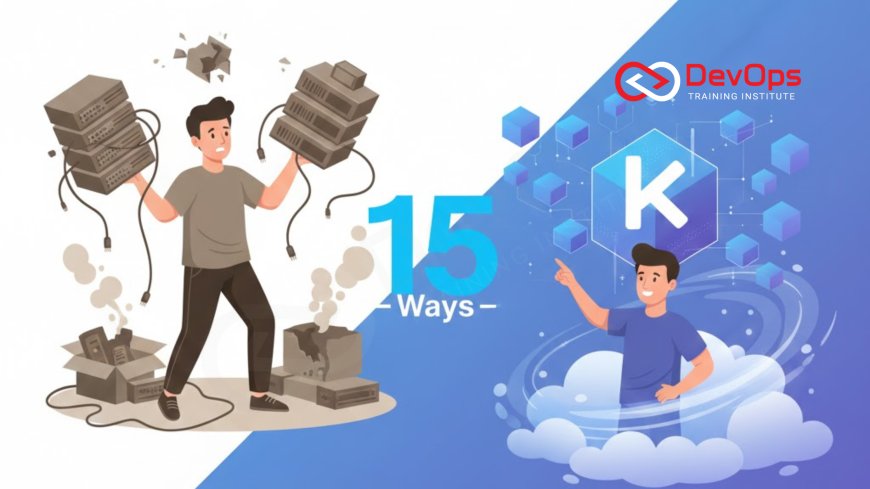
15 Ways Kubernetes Solves Traditional Deployment Problems
Explore 15 fundamental ways Kubernetes revolutionizes application deployment by solving long-standing, costly, and complex traditional deployment problems. From automating manual scaling and eliminating configuration drift to enforcing service discovery and self-healing infrastructure, Kubernetes offers a transformative solution for running modern applications. Learn how this powerful container orchestrator enables immutable infrastructure, standardizes networking, and drastically reduces the Mean Time To Recovery (MTTR), making software delivery faster, more reliable, and ultimately more efficient than ever before across multi-cloud environments.
Introduction
Before the widespread adoption of containerization and orchestration, deploying and managing applications was often a manual, painful, and error-prone process. Traditional deployment relied on complex shell scripts, manual configuration of virtual machines (VMs), and lengthy procedures for scaling and recovery. This methodology led to configuration drift, where environments diverged over time, inconsistent results between testing and production, and high organizational stress, particularly during unexpected failures. The complexity inherent in these systems significantly hindered the speed at which organizations could deliver new features and respond to market demands, creating a persistent bottleneck in the software delivery pipeline.
Kubernetes, the de facto standard for container orchestration, emerged specifically to solve these profound operational problems. It is a powerful platform designed to automate the deployment, scaling, and management of containerized workloads, fundamentally changing the operational model. By abstracting the application layer from the infrastructure layer, Kubernetes provides a consistent, reliable environment across physical machines, virtual machines, and public clouds. Its declarative approach allows engineers to define the desired state of their system, relying on the control plane to continuously work towards making reality match that declaration, eliminating manual toil and ensuring consistency. This transformation aligns perfectly with the core principles of an efficient DevOps workflow.
This guide explores 15 specific and critical challenges that plagued traditional application deployment and details exactly how Kubernetes provides a robust, automated, and elegant solution for each. Understanding these solutions demonstrates why Kubernetes has become an indispensable tool for any organization seeking to modernize its infrastructure, improve application resilience, and accelerate time-to-market in the competitive landscape of cloud-native computing. By tackling these issues head-on, K8s dramatically simplifies the complexity inherent in managing distributed systems at scale.
Solving System Resilience and Availability
System resilience, the ability to recover gracefully from failure, was historically a manual effort requiring complex monitoring and custom failover scripts. When a server failed, engineers had to manually intervene, leading to lengthy downtime and significant service disruption. Kubernetes solves this by building self-healing capabilities directly into its core architecture. These features are always active, ensuring that the cluster is constantly working to restore the desired state, minimizing downtime, and ensuring high availability without requiring human intervention for every failure event.
Kubernetes addresses resilience through several integrated mechanisms:
1. Automated Self-Healing (Reducing MTTR): Kubernetes Deployments and ReplicaSets constantly monitor the health of the Pods (the smallest deployable units). If a Pod or the entire Worker Node hosting it fails or becomes unresponsive, the Control Plane automatically detects the failure and immediately schedules a replacement Pod on a healthy Node. This self-healing reduces the Mean Time to Recovery (MTTR) from hours or minutes to mere seconds, a feat unattainable with manual processes.
2. Built-in Health Checks (Liveness and Readiness Probes): Traditional systems often only checked if a server was "up." Kubernetes introduces Liveness Probes, which check if the application inside the container is running and healthy. If a Liveness Probe fails, K8s restarts the container, solving software-specific issues automatically. Readiness Probes check if a Pod is ready to accept user traffic, ensuring traffic is only routed to fully initialized instances. This granular health checking prevents end-users from hitting unhealthy services.
3. Eliminating Single Points of Failure: The Kubernetes Control Plane is designed to be distributed and highly available, with its state stored in the distributed database etcd. By running multiple replicas of the Control Plane components across different machines, the entire cluster can continue functioning even if one or more master components fail. This distributed control layer ensures that the orchestration engine itself is resilient, providing a stable management layer for your application workloads.
Standardizing Deployment and Configuration
The complexity of managing configuration across different environments (development, staging, production) often led to "configuration drift," where subtle differences caused bugs that were impossible to reproduce outside of the affected environment. Traditional deployment was imperative—specifying how to achieve a state—leading to fragile, lengthy scripts. Kubernetes tackles this by enforcing declarative, standardized deployment practices using the versioned resource model.
K8s enforces consistency through these solutions:
4. Declarative Configuration: Kubernetes uses YAML files to define the desired state of all resources (Pods, Deployments, Services). Engineers simply declare "I want 5 replicas of App X," and K8s makes it happen. This declarative approach eliminates the need for complex, environment-specific imperative scripts, ensuring that the same YAML file can be used to deploy the application identically across any environment, thereby solving configuration drift.
5. Immutable Infrastructure: Instead of updating or patching an existing container or VM (a mutable process), Kubernetes practices immutability. When a change is needed, K8s builds a new container image and deploys new Pods, systematically replacing the old ones. This ensures that every deployment starts from a clean, known-good state, eliminating the risk of hidden, accumulated configuration problems. The ability to ensure environment parity is a cornerstone of modern cloud infrastructure management.
6. Unified Secrets and Configuration Management: Handling secrets (like database passwords) and application configuration traditionally involved insecure file systems or custom vaults. Kubernetes provides native resources like Secrets and ConfigMaps. Secrets are securely stored and encrypted in etcd and injected directly into the Pods as environment variables or mounted files, standardizing access and eliminating the risk of hard-coding sensitive information directly into application code or images.
Simplifying Networking and Service Access
In traditional hosting, service discovery and internal load balancing were complex, manual processes often requiring external DNS configuration or proprietary load balancers. Applications had trouble finding each other, and scaling required manual updating of load balancer rules. Kubernetes abstracts and automates this network complexity, making it simple for any microservice to find and communicate with any other service within the cluster, regardless of which node it is running on.
Key networking problems solved by K8s:
- 7. Automatic Service Discovery: Pods are ephemeral, meaning their IP addresses change frequently. Kubernetes solves this by introducing the Service resource, which provides a stable, persistent DNS name and IP address. Any Pod can resolve the Service name (e.g., `my-api-service`) and automatically connect to a healthy backend Pod without needing to know its current IP address, a foundational component of reliable microservices architecture.
- 8. Native Load Balancing: The Kubernetes Service resource inherently includes load balancing capabilities. Any traffic directed to a Service's stable IP is automatically and evenly distributed across all available, healthy backend Pods. This built-in functionality eliminates the need for manual configuration of load balancing rules and ensures that traffic is always routed efficiently as services scale up or down.
- 9. Simplified Environment Portability: Because Kubernetes provides a consistent abstraction layer for networking, storage, and compute, the application and its YAML definitions are highly portable. An application deployed on a Kubernetes cluster in AWS (EKS) can be moved to an Azure (AKS) or GCP (GKE) cluster with minimal changes, largely because the fundamental orchestration mechanisms remain identical. This ability to run workloads consistently across heterogeneous environments is key to achieving true vendor flexibility.
Enabling Scaling and Resource Optimization
Manual scaling, where an engineer has to predict traffic and provision servers ahead of time, often resulted in either wasted cloud resources (over-provisioning) or system crashes (under-provisioning). Changing resource limits on a running application was a time-consuming administrative task. Kubernetes automates scaling and optimizes resource usage, leading to significant cost savings and better performance under varying load conditions.
K8s excels in optimization via:
10. Automated Horizontal Scaling: The Horizontal Pod Autoscaler (HPA) automatically adjusts the number of Pod replicas based on observed metrics, such as CPU utilization or custom application metrics. When traffic spikes, the HPA seamlessly provisions new Pods, and when traffic subsides, it scales them down. This ensures optimal resource usage and allows the application to handle unpredictable load effortlessly, reducing the need for constant, manual capacity planning by engineers.
11. Optimized Resource Utilization: Traditional VM hosting often wastes resources because applications are siloed and constrained to one large machine. Kubernetes allows multiple Pods to share the resources of a single Worker Node efficiently. By defining resource requests and limits (CPU and Memory) for each container, the Kube-scheduler can intelligently pack Pods onto Nodes, maximizing density and overall server utilization. This ability to efficiently pack workloads onto machines is crucial for managing cloud costs.
12. Seamless Rolling Updates and Rollbacks: Updating an application traditionally involved painful, high-risk "big bang" releases or custom scripts to manage a rolling rollout. Kubernetes Deployments automate rolling updates by gradually replacing old Pods with new ones, ensuring the service remains available throughout the process. Furthermore, if a new deployment introduces a bug, the system allows for an immediate, single-command rollback to the previous stable version, drastically simplifying deployment risk management.
| Traditional Problem Area | The Kubernetes Solution (Concept) | Primary Benefit |
|---|---|---|
| Unplanned Failures & Long Downtime | Automated Self-Healing | Near-instant recovery (low MTTR) without human intervention. |
| Configuration Drift Across Environments | Declarative Configuration (YAML) | Guaranteed environment consistency and reproducibility. |
| Manual Traffic Management & Scaling | Service Discovery & Horizontal Pod Autoscaler (HPA) | Automatic scaling based on demand and stable communication endpoints. |
| High-Risk, Complex Releases | Automated Rolling Updates and Rollbacks | Zero-downtime deployments and instant reversion to a stable state. |
| Insecure Secrets Handling | Native Secrets Resource | Secure, encrypted injection of credentials into application Pods. |
Empowering Development and Security Teams
Traditional operations often created a bottleneck for developers, who had to wait for infrastructure provisioning or manual deployment steps. Security was typically a late-stage hurdle, often referred to as "throwing it over the wall." Kubernetes empowers both development and security teams by providing standardized interfaces and integrating security into the deployment lifecycle, accelerating the DevSecOps transformation.
K8s drives this cultural and technical shift through:
13. Abstraction of Infrastructure Details: Developers no longer need to worry about the underlying VM operating system, patching schedules, or specific cloud hardware. They simply build a standard container image and define its requirements in a portable YAML file. This clear separation of concerns allows developers to focus entirely on application logic and feature development, accelerating the coding process and removing cognitive load, a core principle of effective DevOps tooling.
14. Integrated Network Security Policies: Traditional network security involved firewall rules and complex VLAN management. Kubernetes uses NetworkPolicy resources to define application-level firewall rules, controlling which Pods can communicate with each other (e.g., only the web front-end can talk to the database). This security is defined as code alongside the application, enabling fine-grained, standardized network isolation that helps align with advanced security in the DevOps pipeline.
Addressing Vendor Lock-in and Cloud Flexibility
The reliance on cloud-specific VMs, databases, and networking services often ties organizations tightly to a single provider, making migration difficult and costly. This vendor lock-in reduces negotiating power and limits the ability to choose the best services across different clouds. Kubernetes provides a crucial layer of abstraction that mitigates this risk by providing a standardized API and application management interface.
15. Multi-Cloud and Hybrid Cloud Enablement: Kubernetes acts as an operating system for the cloud, providing the same API and functional interface regardless of whether you are running it on AWS, Azure, GCP, or on-premise. This unified experience ensures that application deployment processes are standardized across all hosting environments, facilitating a true multi-cloud or hybrid-cloud strategy. By enabling this portability, K8s significantly reduces the threat of vendor lock-in and allows organizations to leverage the unique services and pricing advantages of different cloud platforms, providing maximum flexibility.
Conclusion
Kubernetes is more than just a container manager; it is a comprehensive solution that systematically dismantles the 15 most significant operational challenges of traditional application deployment. By introducing self-healing capabilities, declarative configuration, automated scaling, and simplified networking, K8s removes the friction points that historically stalled software delivery, resulting in massive gains in efficiency, reliability, and speed. The shift to Kubernetes is a commitment to automation, immutability, and a cloud-native mindset.
For organizations seeking to survive and thrive in a world that demands continuous, high-velocity software delivery, Kubernetes is no longer optional. It provides the essential operational framework that empowers development teams, satisfies security requirements, optimizes resource utilization, and ensures application resilience in the face of inevitable failures. By embracing the power of orchestration, teams can spend less time firefighting and more time innovating, securely delivering value faster to their customers, thereby ensuring that their investment in DevOps practices yields maximum business return.
Frequently Asked Questions
What is configuration drift and how does Kubernetes prevent it?
Drift is when environments diverge manually. K8s prevents it using declarative YAML configurations that define and enforce the desired state automatically.
How does Kubernetes enable automated scaling?
The Horizontal Pod Autoscaler (HPA) monitors CPU usage or custom metrics and automatically creates or terminates Pod replicas to match demand.
What is the difference between a Pod and a Service?
A Pod runs the application code, while a Service provides a stable, persistent network address and load balancing for a set of ephemeral Pods.
How does K8s help reduce Mean Time to Recovery (MTTR)?
K8s reduces MTTR by automatically detecting failed Pods or Nodes and instantly scheduling replacements, minimizing human intervention and downtime.
What are Liveness and Readiness Probes used for?
Liveness Probes check if an application needs to be restarted, and Readiness Probes check if a Pod is ready to receive network traffic.
Does Kubernetes solve all networking problems?
No, it abstracts them. It still relies on an external CNI plugin to establish the underlying networking between Pods and Nodes.
How does Kubernetes manage application secrets?
It uses the native Secrets resource to store sensitive data encrypted in etcd and securely injects them into Pods as files or variables.
What is "Immutable Infrastructure" in K8s?
It means when an application changes, new Pods are deployed to replace old ones, instead of modifying the existing running environment.
Is Kubernetes only for microservices?
While optimized for microservices, Kubernetes can effectively manage monolithic applications, but its benefits are more pronounced in distributed systems.
How does K8s empower developers?
It abstracts infrastructure concerns, allowing developers to focus solely on their code and define their deployment needs using simple, portable YAML.
What is the role of etcd in the Control Plane?
etcd is the highly available key-value store that acts as the single source of truth for the entire cluster's configuration and desired state.
How does K8s help reduce cloud vendor lock-in?
It provides a standardized orchestration API that is the same across all major cloud providers, making workloads highly portable across platforms.
Can Kubernetes perform deployment rollbacks?
Yes, the Deployment resource automatically tracks revision history, allowing for single-command, near-instantaneous rollbacks to a previous stable state.
How does K8s enable DevSecOps?
By enforcing security policies as code via NetworkPolicy and standardizing secret management, making security an automated, integrated part of the pipeline.
What is the most critical cultural shift needed to adopt K8s?
The shift is embracing the declarative model, trusting the platform to maintain the desired state, and focusing engineer effort on definition rather than manual execution.
What's Your Reaction?
 Like
1
Like
1
 Dislike
0
Dislike
0
 Love
0
Love
0
 Funny
0
Funny
0
 Angry
0
Angry
0
 Sad
0
Sad
0
 Wow
0
Wow
0


![100+ Azure DevOps Interview Questions and Answers [Updated 2025]](https://www.devopstraininginstitute.com/blog/uploads/images/202509/image_140x98_68c40aa9a3834.jpg)






![Future Scope of DevOps Careers in Pune [Updated 2025]](https://www.devopstraininginstitute.com/blog/uploads/images/202510/image_140x98_68e3a84652312.jpg)