


![Kong Interview Preparation Guide [2025]](https://www.devopstraininginstitute.com/blog/uploads/images/202509/image_430x256_68dbb95326997.jpg)

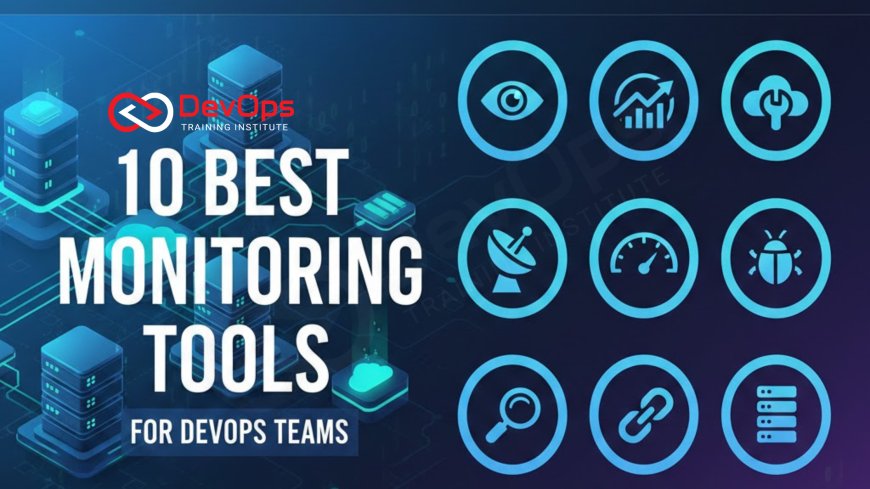
10 Best Monitoring Tools for DevOps Teams
Discover the top 10 monitoring tools every DevOps team needs in 2025. From real-time metrics and log analysis to full-stack observability, these solutions help you detect issues fast, reduce downtime, and keep applications running smoothly.
Introduction
Monitoring is the heartbeat of modern DevOps practices. With microservices, containers, and cloud-native environments, teams need instant visibility into infrastructure, applications, and user experience. The right monitoring tool catches problems before they affect customers, speeds up troubleshooting, and supports data-driven decisions. This guide walks you through the ten most powerful and widely adopted monitoring solutions available today, covering both open-source favorites and enterprise-grade platforms that work seamlessly with serverless workloads like AWS Lambda.
1. Prometheus + Grafana
- Open-source leader designed for cloud-native and Kubernetes environments
- Pull-based metrics collection with powerful PromQL query language
- Excellent service discovery and relabeling for dynamic infrastructures
- Native alerting through Alertmanager with silencing and inhibition rules
- Grafana provides stunning, customizable dashboards and Loki for logs
- Lightweight and highly scalable with remote storage options
- Strong community support and hundreds of exporters
2. Datadog
Datadog has become the go-to full-stack observability platform for many enterprises. It combines infrastructure monitoring, APM, log management, synthetic testing, and real-user monitoring in a single pane of glass. The agent is easy to deploy across clouds, containers, and serverless functions. Teams love the out-of-the-box dashboards, machine-learning-based anomaly detection, and seamless integrations with over 600 technologies.
3. New Relic
- One unified telemetry database for metrics, events, logs, and traces
- Instant AI-powered root cause analysis with New Relic Instant Observability
- Full-stack application performance monitoring with code-level insights
- Live entity maps that show relationships between services automatically
- Strong support for OpenTelemetry standards
- Flexible pricing including a generous free tier
4. Splunk
Splunk remains the gold standard for log management and security analytics. Its powerful search processing language (SPL) lets engineers dig deep into massive datasets quickly. With Splunk Observability Cloud, teams now get real-time metrics, traces, and AI-driven insights alongside traditional logs, making it easier than ever to debug Lambda functions using CloudWatch Logs and other sources.
5. ELK Stack (Elastic)
- Elasticsearch for lightning-fast search and analytics
- Logstash and Beats for flexible data ingestion pipelines
- Kibana dashboards with powerful visualization and Machine Learning features
- Elastic APM for distributed tracing and application performance
- Security analytics and SIEM capabilities built-in
- Can be self-hosted or used via Elastic Cloud
- Excellent for handling massive log volumes at scale
6. Zabbix
Zabbix is a mature, enterprise-ready open-source solution that monitors everything from servers and network devices to cloud services and IoT. It offers agent-based and agentless monitoring, auto-discovery, and a flexible template system. Many organizations choose Zabbix when they need strong network monitoring alongside application metrics.
7. Nagios (and Nagios XI)
The grandfather of open-source monitoring still powers thousands of data centers. Nagios excels at infrastructure health checks and alerting. While the core is showing its age, Nagios XI provides a modern web interface and powerful reporting that helps teams follow best practices for scalable Lambda functions and other workloads.
8. Grafana Cloud (with Mimir, Tempo, and Loki)
- Managed Prometheus-compatible metrics at massive scale (Mimir)
- Distributed tracing backend (Tempo) that works with any tracing format
- Log aggregation and exploration (Loki) with LogQL
- Unified dashboards across metrics, logs, and traces
- Free tier includes generous retention and query limits
- Pay-as-you-go pricing beyond free limits
9. Dynatrace
Dynatrace offers true full-stack, AI-driven observability with automatic topology discovery. Its Davis AI engine correlates issues across the entire stack and suggests precise root causes. One-agent deployment captures metrics, traces, logs, and user experience data without manual configuration, dramatically reducing Lambda cold start times and other latency problems.
10. AppDynamics
AppDynamics, now part of Cisco, focuses heavily on business transaction monitoring and application performance. It shines at mapping how code changes impact customer experience and revenue. Strong integration with Cisco networking and security tools makes it popular in large enterprises.
Quick Comparison Table
| Tool | Open Source | Best For | Pricing Model |
|---|---|---|---|
| Prometheus + Grafana | Yes | Kubernetes & cloud-native | Free / Paid hosted |
| Datadog | No | Full-stack observability | Per host / per GB |
| New Relic | No | Developer-friendly APM | Usage-based |
| Splunk | No | Log & security analytics | Ingest-based |
| ELK Stack | Yes | Large-scale logging | Free / Elastic Cloud |
| Zabbix | Yes | Network & infrastructure | Free / Enterprise support |
| Nagios | Yes | Traditional IT monitoring | Free / XI paid |
| Grafana Cloud | Mixed | Managed open-source stack | Free tier + pay-as-you-go |
| Dynatrace | No | AI-driven enterprise | Per host |
| AppDynamics | No | Business transaction focus | Per CPU core |
Conclusion
Choosing the right monitoring tool depends on your stack, budget, team expertise, and scale. Open-source solutions like Prometheus, Grafana, and ELK offer incredible power and flexibility at zero license cost, while commercial platforms like Datadog, New Relic, and Dynatrace deliver faster time-to-value and advanced AI features. Many successful DevOps teams combine multiple tools (for example, Prometheus for metrics + Loki for logs + Jaeger for traces) under unified Grafana dashboards. Start with your biggest pain point today, then evolve toward a complete observability strategy that keeps your services reliable and your team happy.
Frequently Asked Questions
Which monitoring tool is best for Kubernetes?
Prometheus combined with Grafana is the de-facto standard in the Kubernetes ecosystem, used by most CNCF projects.
Is Datadog worth the cost?
For teams needing unified metrics, logs, traces, and synthetics with minimal setup, Datadog often pays for itself through faster incident resolution.
Can I replace Splunk with open-source tools?
Yes, many organizations migrate to the Elastic Stack or Grafana Loki for cost savings while retaining powerful search capabilities.
What is the easiest monitoring tool for beginners?
Grafana Cloud offers the fastest onboarding experience with generous free tiers and pre-built dashboards.
Does New Relic support OpenTelemetry?
Yes, New Relic is one of the strongest OpenTelemetry supporters and ingests all OTLP data natively.
Which tool has the best alerting?
Prometheus Alertmanager, Datadog, and Dynatrace consistently rank highest for flexible, reliable alerting.
Should we use one tool or multiple?
Most mature teams use a combination: one primary metrics store, a log solution, and a tracing backend, unified through dashboards.
Is Zabbix still relevant in 2025?
Absolutely. Zabbix remains popular for network device monitoring and environments that need agentless checks.
Which tool offers the best free tier?
Grafana Cloud currently provides the most generous free limits for metrics, logs, and traces combined.
How important is AI in monitoring tools today?
AI-powered anomaly detection and root-cause analysis (found in Dynatrace, Datadog, and New Relic) dramatically reduce mean-time-to-resolution in complex systems.
What's Your Reaction?
 Like
0
Like
0
 Dislike
0
Dislike
0
 Love
0
Love
0
 Funny
0
Funny
0
 Angry
0
Angry
0
 Sad
0
Sad
0
 Wow
0
Wow
0

![100+ Azure DevOps Interview Questions and Answers [Updated 2025]](https://www.devopstraininginstitute.com/blog/uploads/images/202509/image_140x98_68c40aa9a3834.jpg)



![Future Scope of DevOps Careers in Pune [Updated 2025]](https://www.devopstraininginstitute.com/blog/uploads/images/202510/image_140x98_68e3a84652312.jpg)