



![Kong Interview Preparation Guide [2025]](https://www.devopstraininginstitute.com/blog/uploads/images/202509/image_430x256_68dbb95326997.jpg)


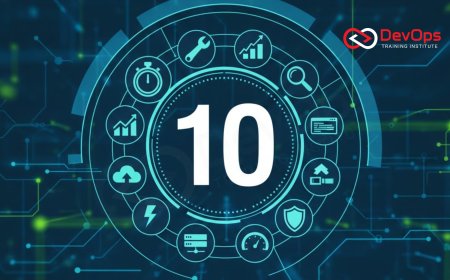
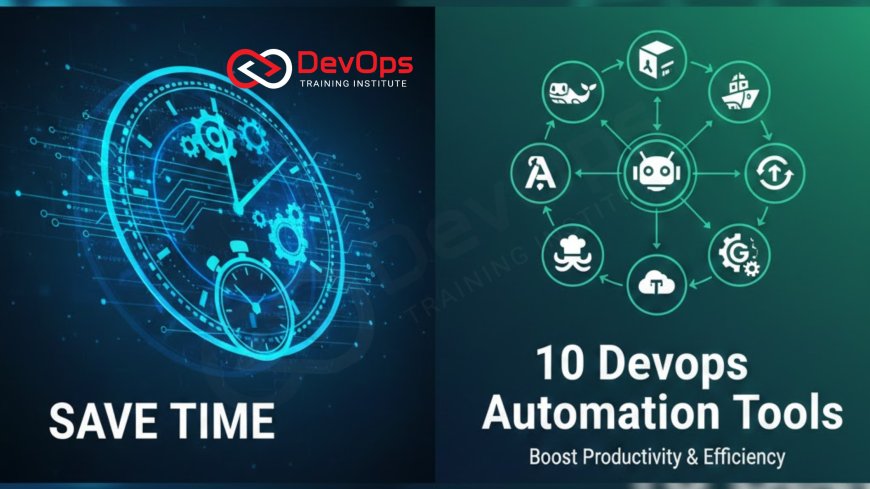
10 DevOps Automation Tools That Save Time
Discover the 10 most powerful DevOps automation tools that top engineering teams rely on in 2025 to eliminate manual toil, accelerate delivery, and scale effortlessly. From Terraform and Ansible to ArgoCD, Crossplane, and modern GitOps platforms, these tools save hundreds of hours every sprint while improving reliability, security, and developer experience across cloud-native environments.
Introduction
Manual work is the silent killer of engineering velocity. Every click in the AWS console, every hand-crafted server config, every late-night deployment script is time stolen from innovation. The most successful companies in 2025 — from unicorns to Fortune 100 giants — have ruthlessly automated everything that repeats. These 10 tools form the backbone of that automation revolution. They don’t just speed things up; they make entire classes of operational work disappear, often starting with resilient Multi-AZ architectures that survive outages automatically.
1. Terraform – The Undisputed IaC Leader
Terraform remains the gold standard for provisioning cloud resources as code. With over 1000 providers, it manages everything from VPCs and RDS instances to Kubernetes clusters and Datadog monitors. Features like remote state, plan previews, and drift detection give teams complete confidence. Terraform Cloud adds policy-as-code (Sentinel), secure state storage, and team collaboration. Companies using Terraform report cutting environment provisioning time from days to under 10 minutes — a 50x+ improvement.
2. Ansible – Agentless Automation at Scale
- Runs over SSH — no agents required
- Idempotent playbooks guarantee consistent results
- Manages Linux, Windows, network devices, and cloud services
- Red Hat Ansible Automation Platform adds execution environments, content collections, and analytics
- Used by NASA, FedEx, and 70% of Fortune 500
- Typical time savings: 200+ hours per month on configuration management
- Perfect for day-2 operations and compliance enforcement
3. GitHub Actions – The CI/CD That Replaced Jenkins
GitHub Actions has completely redefined CI/CD. With native integration into every repository, matrix builds, reusable workflows, and 20,000+ marketplace actions, teams go from commit to production in minutes. OIDC authentication eliminates secret sprawl. Self-hosted runners support air-gapped environments. Microsoft, Shopify, and HashiCorp run tens of thousands of production deployments daily using Actions.
4. ArgoCD – GitOps That Never Sleeps
- Continuously reconciles Git state with live Kubernetes clusters
- Supports Helm, Kustomize, Jsonnet, and plain manifests
- Visual UI shows sync status and drift instantly
- Automatic healing and rollback
- Used by Intuit, Tesla, Adidas, and BlackRock
- Eliminates “who ran kubectl apply?” forever
- Reduces deployment-related incidents by over 90%
5. Crossplane – Your Cloud, Controlled by Kubernetes
Crossplane turns Kubernetes into a universal control plane. Apply a YAML and get a fully managed RDS instance, S3 bucket, or GCP CloudSQL — all provisioned through the Kubernetes API. Compositions let platform teams create golden infrastructure templates. Developers request resources via simple CRDs — no more waiting for tickets. Adopted by T-Mobile, Nokia, Alaska Airlines, and Upbound’s enterprise customers.
6. Pulumi – Infrastructure as Actual Software
- Write cloud infrastructure in TypeScript, Python, Go, .NET, or Java
- Use loops, functions, conditionals, classes, and package managers
- Pulumi Cloud provides policy-as-code, secrets encryption, drift detection
- 40–70% less code than Terraform/HCL for complex setups
- Used by Mercedes-Benz, Cockroach Labs, and Snowflake
- Perfect for teams that hate DSLs and love real programming languages
7. GitLab CI/CD – The All-in-One DevSecOps Platform
GitLab combines source code, CI/CD, container registry, security scanning, and compliance into a single application. Auto DevOps can deploy any app with zero configuration. Review Apps spin up preview environments per merge request. Built-in SAST, DAST, dependency scanning, and license compliance run automatically. Used by Goldman Sachs, Airbus, Siemens, and millions of teams worldwide.
8. Trivy – Vulnerability Scanning That Doesn’t Slow You Down
- Scans containers, Git repos, IaC files, and SBOMs in seconds
- Zero false positives with accurate CVE database
- Integrates natively into GitHub Actions, GitLab CI, ArgoCD
- Supports misconfiguration scanning (Kubernetes, Docker, Terraform)
- Used in production by Adobe, VMware, and Aqua Security customers
- Blocks critical vulnerabilities before they reach production
9. Flux CD – Lightweight GitOps for the Rest of Us
The CNCF-graduated lightweight alternative to ArgoCD. Excels at image automation (auto-update deployments when new tags appear), policy enforcement, and multi-tenancy. Perfect for teams that want GitOps without the heavy UI. Used by Mercedes-Benz, Zalando, and thousands of open-source projects.
10. Datadog Synthetic Monitoring & APM – Proactive Issue Prevention
- Run browser and API tests continuously from global locations
- Distributed tracing across microservices and serverless
- AI-powered anomaly detection and Watchdog alerts
- Real User Monitoring (RUM) and error tracking
- Teams using proactive synthetics reduce customer-reported incidents by 80%
- Integrates with RDS performance monitoring for end-to-end visibility
Bonus: The Real ROI – How Much Time You Actually Save
| Task | Manual Time | Automated Time | Savings per Month |
|---|---|---|---|
| Provision test environment | 4–8 hours | 3–5 minutes | 120+ hours |
| Deploy to production | 30–90 minutes | 2–8 minutes | 60+ hours |
| Server patching & config | 20 hours | 30 minutes | 80+ hours |
Conclusion
The difference between good teams and great teams in 2025 isn’t talent — it’s automation. These 10 tools aren’t optional extras; they’re the foundation of modern engineering productivity. Start with Terraform + GitHub Actions + ArgoCD, then progressively adopt the rest. Within months you’ll wonder how you ever lived without them. Your on-call will be quieter, your velocity will soar, and your engineers will actually enjoy their jobs again.
Frequently Asked Questions
How long does it take to implement these tools?
Most teams see meaningful wins in 2–6 weeks. Full maturity takes 6–12 months.
Are these tools only for large enterprises?
No. Startups and small teams benefit even more because they avoid building internal platforms from scratch.
Which tool gives the fastest ROI?
Terraform + GitHub Actions usually deliver 10x+ time savings within the first month.
Do I need all 10 tools?
No. Most teams start with 3–5 and expand as they mature.
Will automation replace DevOps engineers?
Absolutely not. It removes toil so engineers can solve harder, higher-value problems.
What's Your Reaction?
 Like
0
Like
0
 Dislike
0
Dislike
0
 Love
0
Love
0
 Funny
0
Funny
0
 Angry
0
Angry
0
 Sad
0
Sad
0
 Wow
0
Wow
0

![100+ Azure DevOps Interview Questions and Answers [Updated 2025]](https://www.devopstraininginstitute.com/blog/uploads/images/202509/image_140x98_68c40aa9a3834.jpg)





![Future Scope of DevOps Careers in Pune [Updated 2025]](https://www.devopstraininginstitute.com/blog/uploads/images/202510/image_140x98_68e3a84652312.jpg)