



















![Kong Interview Preparation Guide [2025]](https://www.devopstraininginstitute.com/blog/uploads/images/202509/image_430x256_68dbb95326997.jpg)










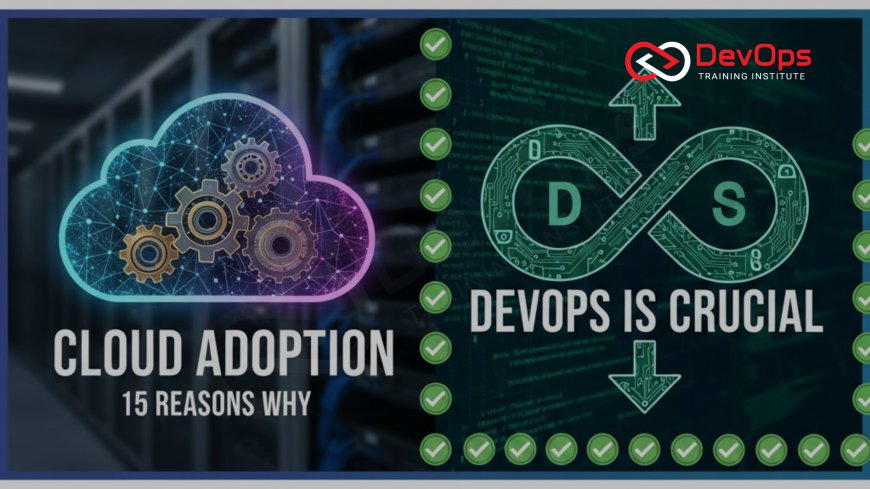
15 Reasons Why DevOps Is Crucial for Cloud Adoption
Discover why DevOps has become the most important success factor for cloud adoption in 2025 and beyond. This comprehensive guide explains 15 powerful reasons that leading organizations rely on DevOps practices to unlock the full potential of AWS, Azure, and Google Cloud. From dramatic cost reduction and faster time-to-market to enhanced security, scalability, and innovation, learn how combining DevOps culture and tools with cloud infrastructure creates a competitive advantage that traditional IT approaches simply cannot match in today’s fast-moving digital landscape.
Introduction
The cloud promises unlimited scale, global reach, and pay-as-you-go pricing, but many companies discover that simply lifting and shifting applications to the cloud does not deliver the expected benefits. In fact, without the right practices, cloud can become more expensive and complex than on-premises infrastructure. This is where DevOps becomes absolutely essential. DevOps is not just a set of tools or a job title; it is a culture, mindset, and collection of practices that enable organizations to fully harness cloud capabilities. Companies that successfully combine DevOps with cloud adoption consistently outperform their peers in speed, reliability, cost efficiency, and innovation.
1. Speed: From Months to Minutes
Traditional IT provisioning could take weeks or months. With cloud and DevOps working together, entire environments spin up in minutes. Infrastructure as code tools like Terraform and AWS CloudFormation, combined with CI/CD pipelines, allow teams to create consistent, repeatable environments on demand. Developers no longer wait for tickets to be processed; they get self-service access to production-like environments instantly. This dramatic reduction in lead time directly translates to faster feature delivery and quicker response to market changes.
How DevOps Accelerates Cloud Provisioning
- Automated templates replace manual console clicks
- Pipeline triggers create environments automatically on every pull request
- Ephemeral environments are destroyed after testing, saving money
- Teams deploy multiple times per day instead of once per quarter
2. Cost Optimization and Financial Control
One of the biggest cloud surprises is how quickly costs can spiral without proper controls. DevOps practices provide the visibility and automation needed to keep spending in check. Tools automatically right-size instances, shut down unused resources, and purchase reserved instances at optimal times. More importantly, DevOps culture encourages ownership of costs at the team level rather than treating cloud spend as someone else’s problem.
Real Cost-Saving Mechanisms
| Mechanism | How DevOps Enables It | Typical Savings |
|---|---|---|
| Auto-scaling | CI/CD deploys scaling policies as code | 30-60% |
| Spot instances | Pipeline automatically uses cheapest compute | 70-90% |
| Resource tagging | Enforced through policy-as-code | Better cost allocation |
3. Enhanced Security and Compliance
Security used to be a blocker for cloud adoption. DevOps changes this completely by embedding security throughout the lifecycle, an approach known as DevSecOps. Instead of security being a separate phase, it becomes part of every commit and deployment. Automated scanning, policy enforcement, and immutable infrastructure make cloud environments significantly more secure than traditional data centers.
4. Reliability Through Automation
Cloud outages make headlines, but the truth is that cloud platforms are far more reliable than most on-premises infrastructure. When combined with DevOps practices like automated testing, canary deployments, and chaos engineering, reliability reaches unprecedented levels. Teams can deploy with confidence knowing that extensive automated checks have validated every change.
- Automated rollback on failure
- Feature flags for safe rollouts
- Chaos Monkey testing in production
- Observability built into every service
5. Scalability Becomes a Feature, Not a Project
In the cloud era, scaling should be automatic and invisible to users. DevOps practices make this reality by implementing auto-scaling groups, horizontal pod autoscalers, and serverless architectures as standard patterns. What used to require months of planning and procurement now happens automatically based on real-time demand.
Scaling Examples That Only Work with DevOps
Companies like Netflix handle massive traffic spikes during new releases because their entire stack is designed to scale horizontally. When combined with read replicas for RDS scalability, global applications maintain low latency even during peak loads.
6. Better Resource Utilization
Traditional infrastructure often runs at 10-15% utilization. Cloud with DevOps routinely achieves 60-80% utilization through containerization, auto-scaling, and intelligent workload placement. This directly translates to lower costs and reduced carbon footprint.
7. Innovation Velocity
When teams spend less time on operational tasks, they have more capacity for innovation. DevOps automation frees engineers to experiment with new technologies, build customer features, and solve hard problems instead of managing servers.
- A/B testing becomes trivial
- New regions launch in days, not months
- Machine learning models deploy like any other service
- Customer feedback loops shorten dramatically
8. Improved Collaboration and Culture
Cloud breaks down traditional silos between development, operations, and security teams. DevOps culture, enabled by cloud tools, creates shared responsibility and visibility. Everyone can see the same dashboards, logs, and metrics in real time.
Cultural Benefits That Drive Success
Teams that adopt DevOps with cloud report higher employee satisfaction, lower burnout, and better retention. The psychological safety created by automation and blameless postmortems allows organizations to move faster with less fear.
9. Multi-Cloud and Hybrid Strategies Become Feasible
Many organizations want to avoid vendor lock-in or need hybrid capabilities. DevOps practices make this practical through consistent tooling and infrastructure as code. The same Terraform modules work across AWS, Azure, and GCP. Kubernetes provides a consistent runtime layer whether on-premises or in any cloud.
10. Disaster Recovery and Business Continuity
Cloud makes disaster recovery affordable for everyone, but only DevOps makes it automatic and reliable. With infrastructure as code, entire environments can be recreated in another region with a single command. Regular chaos testing ensures recovery actually works when needed.
Automated DR Capabilities
- Pilot light architectures kept warm automatically
- Cross-region replication configured as code
- Failover testing runs monthly without human intervention
- RTO measured in minutes, not days
11. Self-Service for Developers
The biggest productivity killer in traditional IT is waiting for someone else to do something. Cloud plus DevOps enables true self-service: developers can provision databases, message queues, or entire environments without filing tickets. Platform teams provide golden paths and guardrails while giving development teams freedom to move fast.
12. GitOps: The Future of Cloud Operations
GitOps takes center stage as the single source of truth for infrastructure and applications. Tools like ArgoCD and Flux continuously reconcile desired state with reality. This approach provides audit trails, rollback capability, and visibility that traditional operations could never match.
13. Observability and Troubleshooting
Cloud generates massive amounts of telemetry data. DevOps practices turn this into actionable insights through centralized logging, distributed tracing, and real-time metrics. When combined with advanced RDS monitoring tools, teams can identify and fix issues before customers notice them.
14. Compliance and Governance at Scale
Regulatory requirements don’t go away in the cloud; they become more complex. DevOps solves this through policy-as-code, automated evidence collection, and immutable infrastructure. Security and compliance become features of the platform rather than blockers.
15. Competitive Advantage in the Digital Age
The ultimate reason DevOps is crucial for cloud adoption is simple: your competitors are doing it. Companies that master cloud and DevOps move faster, spend less, innovate more, and deliver better customer experiences. In 2025, the question is not whether to adopt DevOps with cloud, but how quickly you can transform your organization to take full advantage of this powerful combination.
Conclusion
The cloud provides incredible technical capabilities, but DevOps provides the cultural and process foundation needed to actually use them effectively. Organizations that treat DevOps as optional when moving to cloud inevitably face higher costs, slower delivery, and increased risk. Those that embrace DevOps as a core part of their cloud strategy unlock massive benefits in speed, cost, reliability, security, and innovation. The evidence is overwhelming: every successful cloud transformation in 2025 and beyond will be powered by strong DevOps practices. The future belongs to organizations that understand cloud and DevOps are not separate initiatives, but two halves of the same successful digital transformation strategy.
Frequently Asked Questions
What happens if we move to cloud without DevOps?
You’ll likely face higher costs, slower delivery, more outages, and security issues. Cloud amplifies existing organizational problems.
How long does it take to see benefits from DevOps in cloud?
Most teams see initial wins within 4-8 weeks. Full transformation typically takes 12-18 months.
Is DevOps more important than choosing the right cloud provider?
Yes. Strong DevOps practices succeed on any cloud platform. Weak practices fail even on the best cloud.
Do small companies need DevOps for cloud?
Absolutely. Small teams benefit even more because automation replaces the need for large operations staff.
Can we implement DevOps after moving to cloud?
Yes, but it’s much harder. Cloud adoption and DevOps transformation should happen together.
How does DevOps help with cloud security?
Through automated security scanning, policy-as-code, immutable infrastructure, and least-privilege principles applied continuously.
What’s the biggest myth about cloud and DevOps?
That cloud automatically makes you agile. Without DevOps practices, cloud often makes organizations slower and more expensive.
How does DevOps reduce cloud costs?
Through auto-scaling, right-sizing, automated cleanup, spot instance usage, and giving teams visibility into their spend.
Is GitOps necessary for cloud success?
Not strictly necessary, but it’s becoming the standard for reliable, auditable cloud operations at scale.
How does DevOps improve developer experience in cloud?
Through self-service infrastructure, fast feedback loops, consistent environments, and reduced operational burden.
Can DevOps help with cloud vendor lock-in?
Yes, by using infrastructure as code and containerization to create portable workloads across providers.
What role does automation play in cloud DevOps?
Automation is the foundation. Everything that can be automated should be, from provisioning to testing to deployment.
How does DevOps enable innovation in cloud?
By removing operational toil, providing fast feedback, and making experimentation safe and inexpensive.
Is serverless the ultimate form of cloud DevOps?
It’s a powerful pattern, but successful organizations use serverless alongside containers and VMs depending on the use case.
What’s the future of DevOps and cloud?
Platform engineering, AI-assisted operations, and even more seamless integration between cloud providers and development tools.
What's Your Reaction?
 Like
0
Like
0
 Dislike
0
Dislike
0
 Love
0
Love
0
 Funny
0
Funny
0
 Angry
0
Angry
0
 Sad
0
Sad
0
 Wow
0
Wow
0



![100+ Azure DevOps Interview Questions and Answers [Updated 2025]](https://www.devopstraininginstitute.com/blog/uploads/images/202509/image_140x98_68c40aa9a3834.jpg)






![Future Scope of DevOps Careers in Pune [Updated 2025]](https://www.devopstraininginstitute.com/blog/uploads/images/202510/image_140x98_68e3a84652312.jpg)