







![Kong Interview Preparation Guide [2025]](https://www.devopstraininginstitute.com/blog/uploads/images/202509/image_430x256_68dbb95326997.jpg)





20 Common DevOps Terms Beginners Must Know
New to DevOps? This 4500+ word beginner-friendly guide explains the 20 most important DevOps terms you will hear every day in 2025–2026. Each term is explained in plain English with real-world examples, common pitfalls, why it matters, and how top companies actually use it. Perfect for fresh graduates, career switchers, managers, and anyone who wants to speak DevOps fluently without feeling lost in meetings.
Introduction: Why DevOps Has Its Own Language
DevOps is one of the fastest-moving fields in tech. New tools, practices, and buzzwords appear every week. When you’re just starting, hearing “we need to shift-left our canaries using GitOps while staying within our error budget” can feel like a foreign language. The good news? Only about 20 core concepts are used in 95% of conversations. Master these 20 terms and you’ll understand stand-ups, read documentation, follow Slack discussions, and confidently contribute from week one. Let’s dive in.
1. CI/CD – Continuous Integration / Continuous Delivery (or Deployment)
The absolute foundation of modern software delivery.
- Continuous Integration (CI): every code push automatically triggers build + unit/integration tests
- Continuous Delivery: tested code is always in a deployable state
- Continuous Deployment: fully automated deployment to production on every merge
Netflix deploys 1000+ times per day using CI/CD. Your team probably aims for multiple times per week.
2. Infrastructure as Code (IaC)
Instead of clicking buttons in AWS console, you write code (Terraform, Pulumi, CDK, Ansible) that defines servers, networks, databases, and permissions.
Benefits:
- Everything is version-controlled and peer-reviewed
- Environments are identical (no “it works in dev but not prod”)
- Instant environment creation and destruction
Read the full case for Infrastructure as Code.
3. GitOps – Git Is the Single Source of Truth
Everything that should exist in your cluster is declared in Git. Tools (ArgoCD, Flux) continuously reconcile reality with Git. If it’s not in Git, it doesn’t exist.
Used by Adidas, Intuit, and most cloud-native companies.
4. Container – The Portable Application Package
A container bundles your app + exact dependencies into one lightweight package. Runs the same on your laptop, CI, or any cloud.
Docker made containers mainstream. 90%+ of production workloads now run in containers.
5. Kubernetes (K8s) – The Container Orchestrator
Kubernetes automates deployment, scaling, networking, storage, and self-healing of containers across clusters of machines.
- Google runs everything on Kubernetes internally
- EKS, GKE, AKS are managed versions
- Over 80% of Fortune 500 use it
6. Immutable Infrastructure
Never log into a server and change it. Instead, build a new image and replace the old server completely. Like replacing a broken phone instead of repairing it.
Enables perfect consistency, fast rollback, and zero configuration drift.
7. DORA Metrics – The Four Key Measures of DevOps Performance
From the annual State of DevOps report:
- Deployment Frequency – how often you deploy
- Lead Time for Changes – code to production time
- Change Failure Rate – % of deploys causing incidents
- Time to Restore Service – how fast you recover
Elite performers deploy multiple times per day with <1% failure rate.
8. Shift Left – Do It Earlier
Move testing, security, performance, and compliance earlier in the process instead of discovering issues late.
Example: run security scans in CI instead of production.
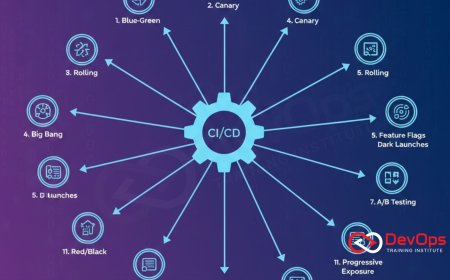
9. Blue-Green Deployment
Two identical environments. Deploy new version to “green” while users stay on “blue”. Switch router when ready. Rollback is instant.
Used when zero-downtime and instant rollback are mandatory.
10. Canary Release – Release to a Few Users First
Send new version to 1–5% of traffic. Monitor errors, latency, business metrics. Gradually increase if healthy.
Safest way to release in production. Used by Google, Facebook, Shopify.
11. Feature Flags (Feature Toggles)
Code switches that let you enable/disable features without new deployments.
- Dark launches
- Kill switches for bad releases
- Gradual rollouts
LaunchDarkly, Unleash, and ConfigCat are popular.
12. Observability – Understanding the Unknown Unknowns
Three pillars: logs, metrics, traces.
Monitoring tells you when something is wrong. Observability lets you debug why.
Tools: Prometheus, Grafana, Jaeger, OpenTelemetry.
See the comparison of CloudWatch vs Prometheus.
13. SRE – Site Reliability Engineering
Google’s approach to operations: treat ops problems as software problems.
- Error budgets
- Toil reduction
- Service Level Objectives (SLOs)
14. Toil – Manual Repetitive Work
Anything manual, repetitive, and automatable (e.g., manually scaling servers, clicking buttons). Google’s goal: keep toil <50% of an SRE’s time.
15. Twelve-Factor App Methodology
12 best practices for building cloud-native apps (config via env vars, stateless processes, etc.). Still the gold standard in 2025.
16. Trunk-Based Development
All developers commit to main branch daily with very short-lived branches. Enables continuous integration at scale.
Used by Google, Netflix, Amazon for thousands of deploys per day.
17. Idempotency
Running an operation 1 time or 100 times has the same effect. Critical for reliable automation tools (Terraform, Ansible).
18. Golden Path / Paved Road
The officially supported, documented, and tool-rich way to do something, provided by platform teams. Reduces cognitive load and increases velocity.
19. Blast Radius
How many users/systems would be affected by a failure. Good architecture keeps blast radius small (microservices, canaries, circuit breakers).
20. Zero Trust Security
Never trust, always verify. No device or user is trusted by default, even inside the network.
Relies heavily on strong identity, least privilege, and the Linux permission model.
DevOps Terms Cheat Sheet Table (2025 Edition)
| Term | One-Sentence Explanation | Elite Performer Target |
|---|---|---|
| CI/CD | Automate everything | Multiple deploys/day |
| GitOps | Git = truth | 100% declarative |
| Canary | Test on 1% first | Default release method |
| Feature Flags | Release ≠ Deploy | All non-trivial features |
Conclusion
Congratulations — you now speak DevOps! These 20 terms form the common language used by every high-performing team in 2025. Bookmark this page, share it with new hires, and refer back whenever you hear something new. The field will keep evolving, but these concepts are the foundation that won’t change. Welcome to the world of modern software delivery — you’ve got this!
Frequently Asked Questions
Is Kubernetes mandatory for DevOps?
No. Many elite teams run serverless or simple VMs with excellent DevOps.
CI vs CD vs CD — which is which?
CI = build+test, CD = automated staging, CD (second) = automated production.
Is GitOps only for Kubernetes?
No — any declarative system (cloud resources, databases) can use GitOps.
Do I need feature flags?
Yes if you want safe, fast releases and the ability to kill bad code instantly.
What is the biggest mistake beginners make?
Treating servers as pets instead of cattle — manually fixing instead of replacing.
Are containers the same as VMs?
No — containers are lighter, start in milliseconds, share kernel.
Why do we care about DORA metrics?
They scientifically predict business performance — higher frequency + stability = more revenue.
Blue-green or canary?
Canary is safer because you can stop at 1%. Blue-green is faster to rollback.
What does “shift left” really mean?
Do testing, security, compliance early — in code, not at the end.
Is SRE different from DevOps?
SRE is Google’s implementation of DevOps principles with strong reliability focus.
What is toil and why avoid it?
Manual repetitive work. Google says keep it <50% of time or burnout follows.
Should I learn Docker or Kubernetes first?
Docker first — it’s the building block. Kubernetes orchestrates Docker containers.
Is “zero trust” just marketing?
No — it’s mandatory for compliance and modern cloud security.
What is a “golden path”?
The blessed, supported way to deploy, provided by your platform team.
Do I need a university degree for DevOps?
No — practical skills, projects, and curiosity matter far more.
What's Your Reaction?
 Like
1
Like
1
 Dislike
0
Dislike
0
 Love
0
Love
0
 Funny
0
Funny
0
 Angry
0
Angry
0
 Sad
0
Sad
0
 Wow
0
Wow
0

![100+ Azure DevOps Interview Questions and Answers [Updated 2025]](https://www.devopstraininginstitute.com/blog/uploads/images/202509/image_140x98_68c40aa9a3834.jpg)






![Future Scope of DevOps Careers in Pune [Updated 2025]](https://www.devopstraininginstitute.com/blog/uploads/images/202510/image_140x98_68e3a84652312.jpg)